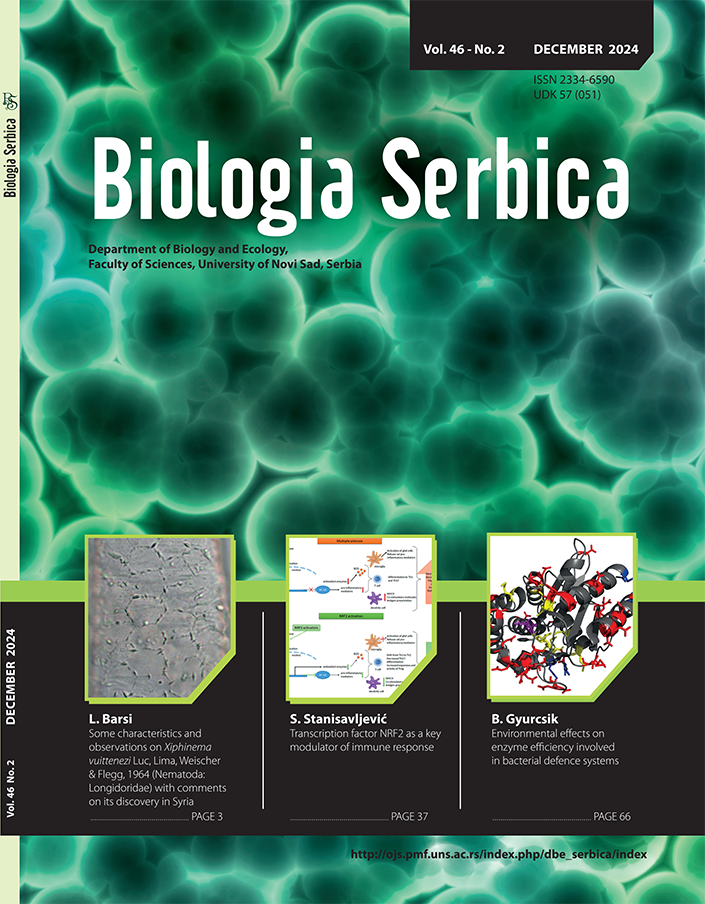
Environmental effects on enzyme efficiency involved in bacterial defence systems
DOI:
https://doi.org/10.5281/zenodo.14537457Keywords:
colicin E7 nuclease domain, bacterial defence, metal ions, TEM-1 β-lactamaseAbstract
Studies on bacterial defence systems are crucial for understanding their mechanism of action and thus, for development of more efficient anibiotics. The enzymes included in these processes are often metalloenzymes, with a metal ion cofactor in their active center. The function of these enzymes is naturally affected by the availability of metal ions. Nevertheless, those enzymes suggested to be metal ion independent, may also be influenced by metal ions encountered in the biological environment. Two types of bacterial defence systems are discussed in this review. (1) TEM-1 β-lactamase, protecting bacteria from β-lactam antibiotics, is not a metalloenzyme but it offers potential sites for metal ion binding. (2) NColE7 is the nuclease domain of the colicin E7 bacterial toxin, being a metallohydrolase purified together with Zn(II). It is suggested by the collected results that non-native metal ions may modify the catalytic mechanism, providing a chance to design more efficient antibiotic compounds.
Downloads
Published
How to Cite
Issue
Section
License
Copyright (c) 2025 Béla Gyurcsik

This work is licensed under a Creative Commons Attribution 4.0 International License.