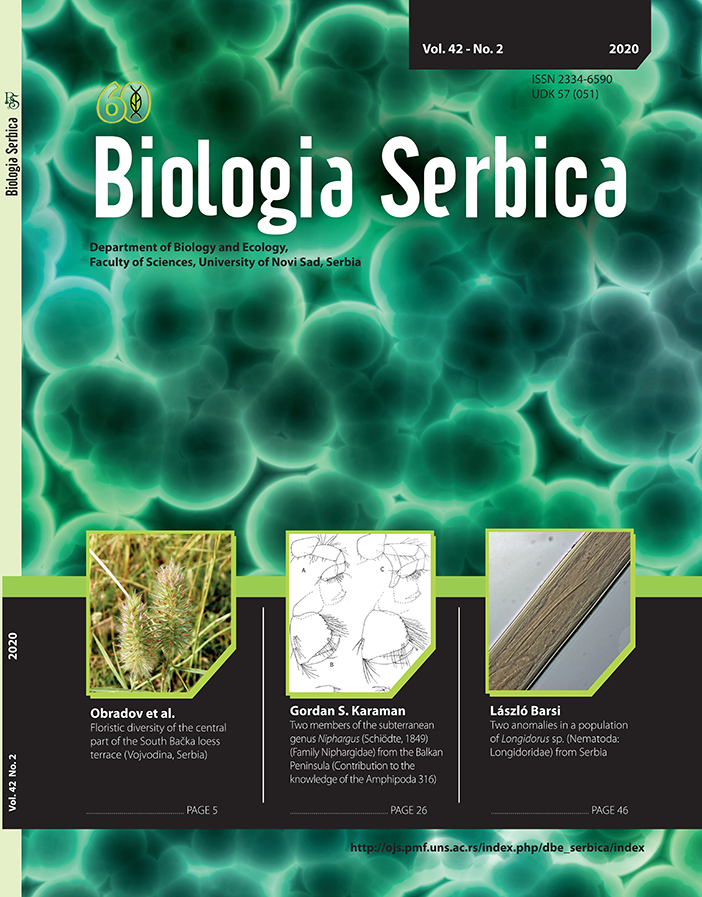
Floristic diversity of the central part of the South Bačka loess terrace (Vojvodina, Serbia)
DOI:
https://doi.org/10.5281/zenodo.4533996Keywords:
areal type spectrum, biological spectrum, invasive plant species, loess, South Bačka, vascular floraAbstract
Three year-long botanical field investigations of the central part of the South Bačka loess terrace were conducted with the purpose to determine the floristic diversity of this primarily agricultural area. A total of 518 vascular plant taxa (504 species and 14 subspecies) were registered and classified into 102 families and 316 genera. The families with the most representatives were Asteraceae, Poaceae, Rosaceae, Fabaceae, Lamiaceae, and Brassicaceae, while the most species-rich genera were Euphorbia, Prunus, Potentilla, Ranunculus, and Rumex. Floral elements were grouped into eight areal types, dominated by the Eurasian areal type. Also, of the 54 noted adventive taxa, 41 had an invasive character. The biological spectrum was characterized by the domination of hemicryptophytes and therophytes. The presence of twenty protected plant species and six tertiary relicts was registered.
Downloads
Published
How to Cite
Issue
Section
License
Copyright (c) 2024 Biologia Serbica

This work is licensed under a Creative Commons Attribution 4.0 International License.